

Best Wood Species for Stair Treads: Oak, Walnut, Ash & More
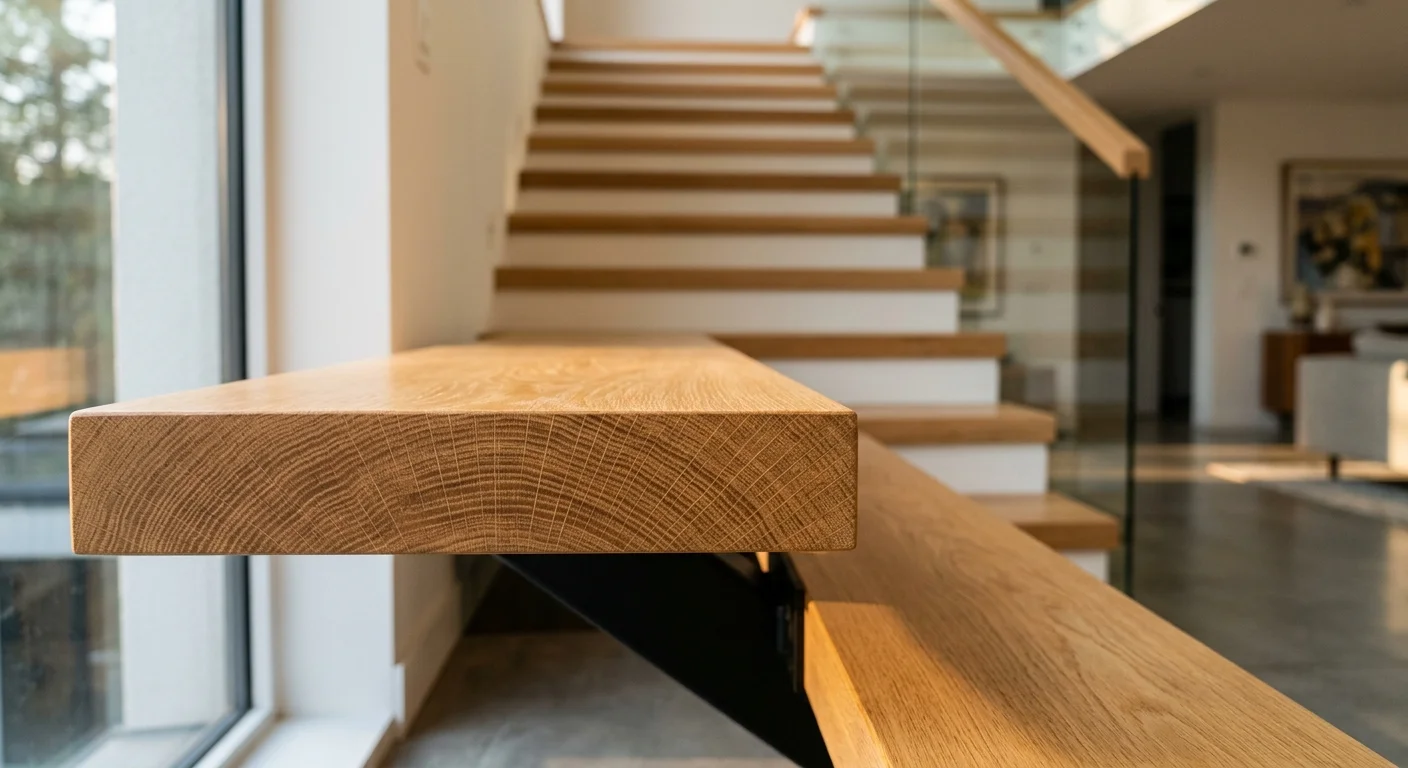
Selecting the best wood for stair treads depends on your household traffic, aesthetic goals, and budget, but for the vast majority of premium installations, White Oak represents the absolute gold standard. White Oak delivers an exceptional balance of wear resistance, structural stability, and a neutral, modern grain that complements contemporary interior designs. For high-traffic areas requiring extreme durability at a slightly lower price point, Hard Maple offers unmatched density and a clean, minimalist look. If your design prioritizes deep, luxurious natural tones, Black Walnut stands as the premier choice, though its softer surface requires more careful maintenance in homes with active pets and children. Meanwhile, Red Oak remains the industry workhorse, offering reliable strength and a traditional grain pattern at an accessible cost. Balancing these wood characteristics with your railing system ensures a cohesive architectural statement. Working with a premium staircase contractor allows you to customize these species to match existing flooring, ensuring that your treads and balustrades function as a single, unified design element.
Key Takeaways
- White Oak is the premier choice for modern, high-end residential staircases, offering unmatched stability, neutral colors, and high rot resistance.
- Hard Maple and White Ash deliver incredible density and wear resistance, making them ideal for heavy foot traffic and Scandinavian-inspired designs.
- Black Walnut provides unparalleled luxury with its rich, dark chocolate tones, though it is softer and requires high-performance protective finishes.
- Always prioritize solid hardwood over thin engineered veneers to ensure the treads can be sanded and refinished multiple times over several decades.
- A wood’s Janka hardness rating directly correlates with its resistance to dents, scratches, and wear under daily residential or commercial use.
What is the Best Wood for Stair Treads by Hardness and Durability?
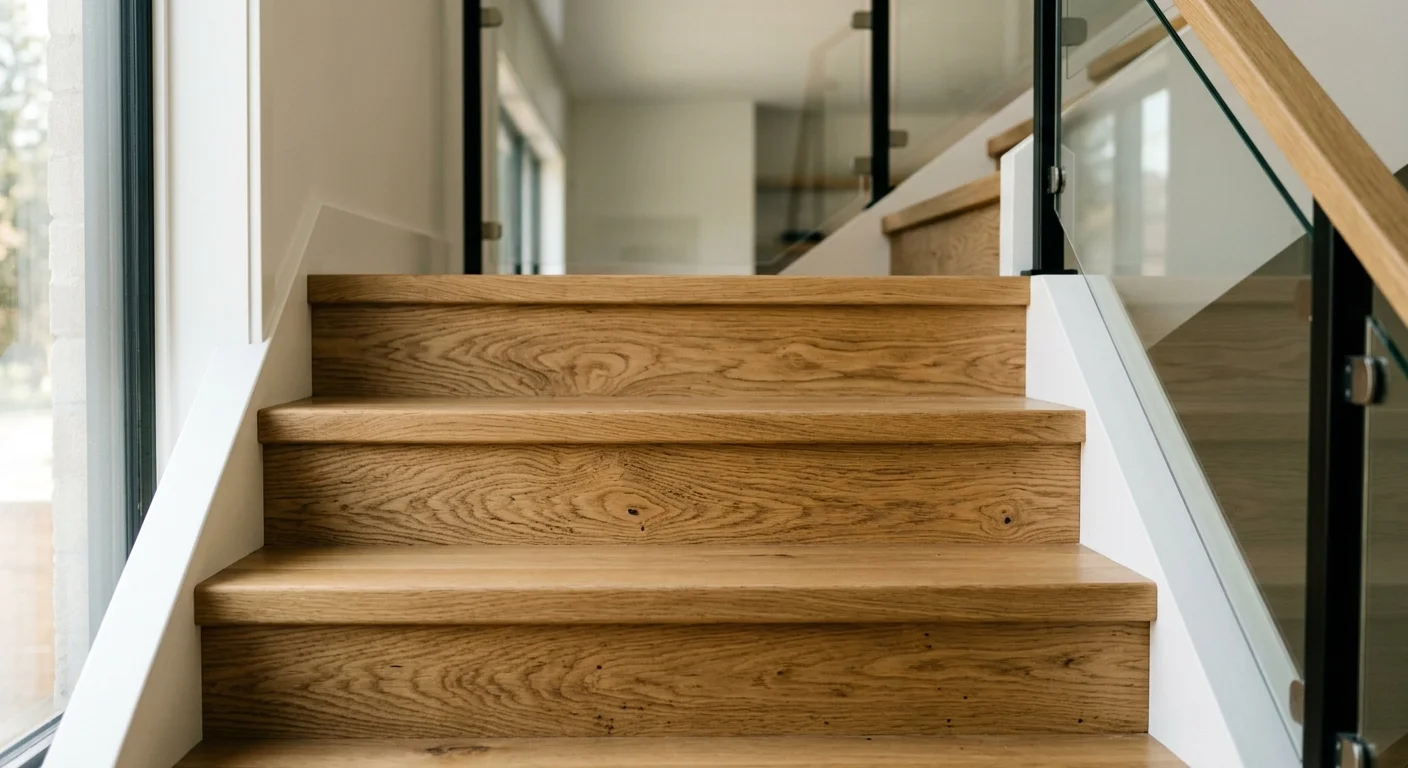
The ideal wood for stair treads must withstand thousands of heavy impacts while maintaining its structural shape, making the Janka hardness rating the single most critical durability metric. This scale measures the force required to embed a small steel ball halfway into a piece of wood. Standard residential building guidelines require structural materials to withstand rigorous daily pressure. According to the International Code Council (ICC), stair treads must support a concentrated load of at least 300 pounds. Choosing a dense hardwood guarantees that your steps will meet this structural demand without sagging, flexing, or showing premature wear.
According to comprehensive wood testing data published by The Wood Database, domestic hardwoods show a wide range of Janka hardness ratings. Hard Maple leads the standard domestic choices at 1,450 lbf (pounds-force). White Oak follows closely at 1,360 lbf, while White Ash sits at 1,320 lbf. Red Oak offers a highly durable 1,290 lbf rating. Conversely, softer woods like Black Walnut measure around 1,010 lbf. Selecting a species with a rating below 1,000 lbf for high-traffic stairs is generally a mistake. Softwoods like Eastern White Pine (380 lbf) or Douglas Fir (710 lbf) will dent, scratch, and gouge under normal shoe traffic within months of installation.
Beyond Janka hardness, wood stability plays a vital role in long-term durability. Wood naturally expands and contracts with changes in indoor humidity. Species with high dimensional stability resist warping, cupping, and checking over time. White Oak is particularly stable due to its unique cellular structure. This structure features microscopic pores clogged with tyloses. These natural blockages prevent water absorption and minimize movement. This cellular makeup makes White Oak highly reliable in humid coastal climates like Florida and California.
White Oak: The Premium Architectural Benchmark
White Oak has secured its position as the premier architectural choice for stair treads due to its exceptional rot resistance, linear grain structure, and compatibility with modern neutral finishes. Homeowners looking to elevate their properties often choose custom white oak stair treads because of their elegant pale brown to tan coloration. This neutral undertone provides a blank canvas for custom stains. It allows designers to achieve anything from wire-brushed ceruse finishes to ultra-matte natural coatings. Unlike Red Oak, White Oak lacks strong pink or reddish undertones, making it far easier to match with modern luxury flooring.
The premium nature of White Oak is reflected in its market pricing and structural performance. The National Hardwood Lumber Association (NHLA) notes that high-grade domestic White Oak commands a premium price due to soaring global demand. Standard White Oak treads typically cost between $120 and $300 each, depending on thickness and width. For thick floating staircases, custom three-inch-thick White Oak slabs can exceed $450 per tread. This investment pays off in structural longevity and aesthetic appeal. The tight grain pattern hides dust and minor scratches exceptionally well over years of use.
To maximize the performance of White Oak, custom manufacturers recommend specific milling cuts. Rift-sawn and quarter-sawn White Oak offer the straightest grain patterns and the highest dimensional stability. These cutting methods yield wood fibers that run perpendicular to the face of the board. This orientation reduces tangential shrinkage by nearly half compared to flat-sawn lumber. As a result, your stair treads remain perfectly flat and tight against their stringers for decades, eliminating annoying squeaks and groans.
Deep-Dive into Hardwood Options: Walnut, Maple, Ash, and Red Oak
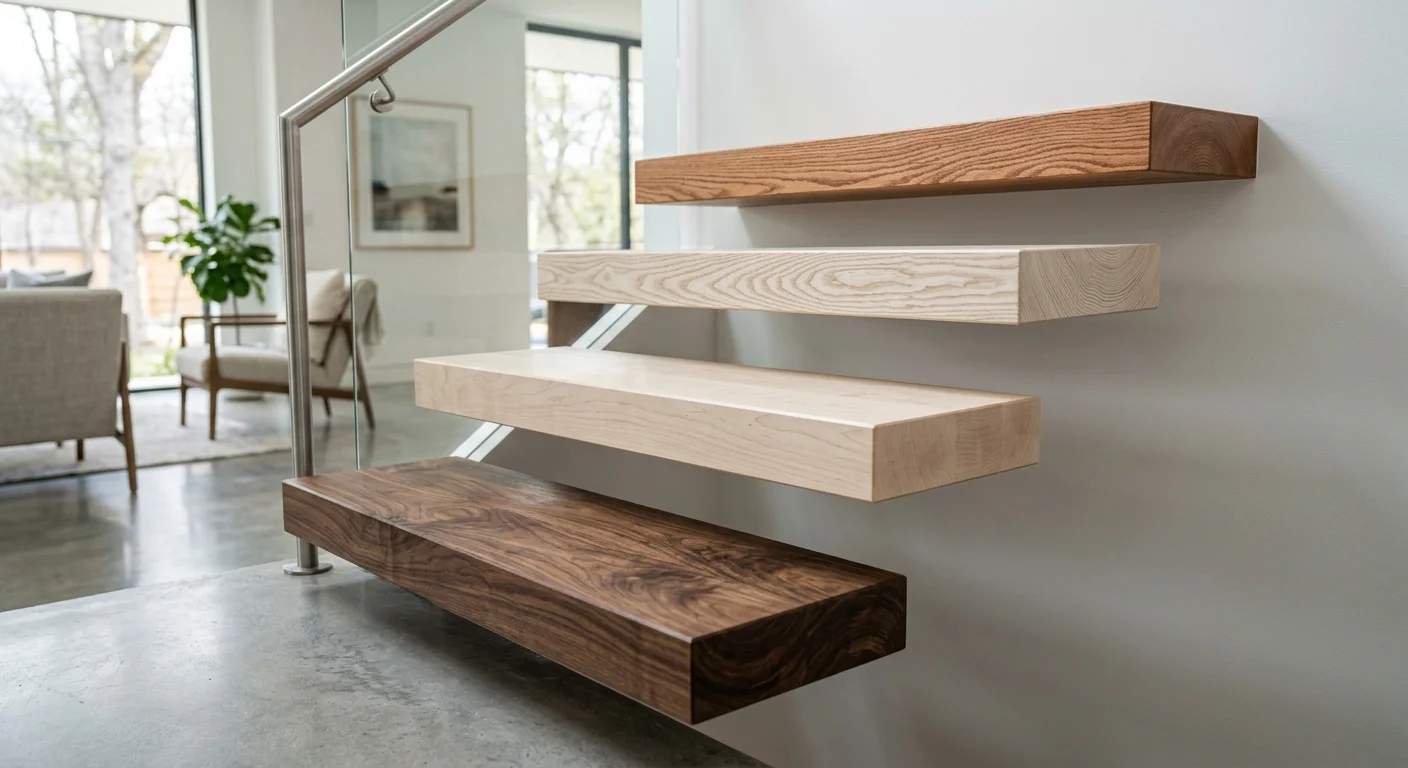
Choosing between other major hardwoods like Walnut, Maple, Ash, and Red Oak requires a careful evaluation of their natural colors, grain behaviors, and mechanical strengths. Each wood species brings a distinct personality and physical capability to a staircase design. Understanding these differences allows you to choose a wood that meets your lifestyle needs and aesthetic goals.
Black Walnut represents the pinnacle of natural luxury, prized for its deep chocolate brown tones and swirling, organic grain patterns. With a Janka hardness of 1,010 lbf, Walnut is softer than Oak or Maple. This means it requires a highly durable clear coat to prevent surface scratching. It is best suited for low-traffic areas, formal staircases, or homes without large pets. Premium Walnut treads are highly sought after, with prices ranging from $180 to $350 or more per tread.
Hard Maple is an incredibly dense, heavy, and impact-resistant wood with a very clean, closed-grain appearance. Its light, creamy color palette is perfect for minimalist, modern, or Scandinavian interiors. However, Maple’s tight cell structure makes it difficult to stain evenly without professional pre-conditioning. It is best finished naturally with a clear protective coat. Hard Maple treads are moderately priced, typically ranging from $90 to $180 per tread.
White Ash is a highly resilient, shock-resistant hardwood with a bold, expressive grain pattern that resembles Red Oak. Rated at 1,320 lbf on the Janka scale, Ash is exceptionally tough and elastic, which is why it is used to manufacture professional baseball bats. It absorbs stains beautifully and offers a modern look when finished with light or white-washed oils. White Ash is an excellent, cost-effective alternative to White Oak, with prices ranging from $80 to $150 per tread.
Red Oak is the traditional backbone of American home construction, offering excellent durability (1,290 lbf) and a warm, welcoming appearance. Its highly porous nature allows it to absorb stains deeply and evenly, making it easy to color-match to existing oak flooring. However, its prominent, swirling grain and pink undertones can look dated if finished with old-fashioned amber polyurethanes. Red Oak remains highly affordable and widely available, with prices ranging from $45 to $110 per tread.
Selecting the Best Wood to Use for Stair Treads Across Different Design Styles
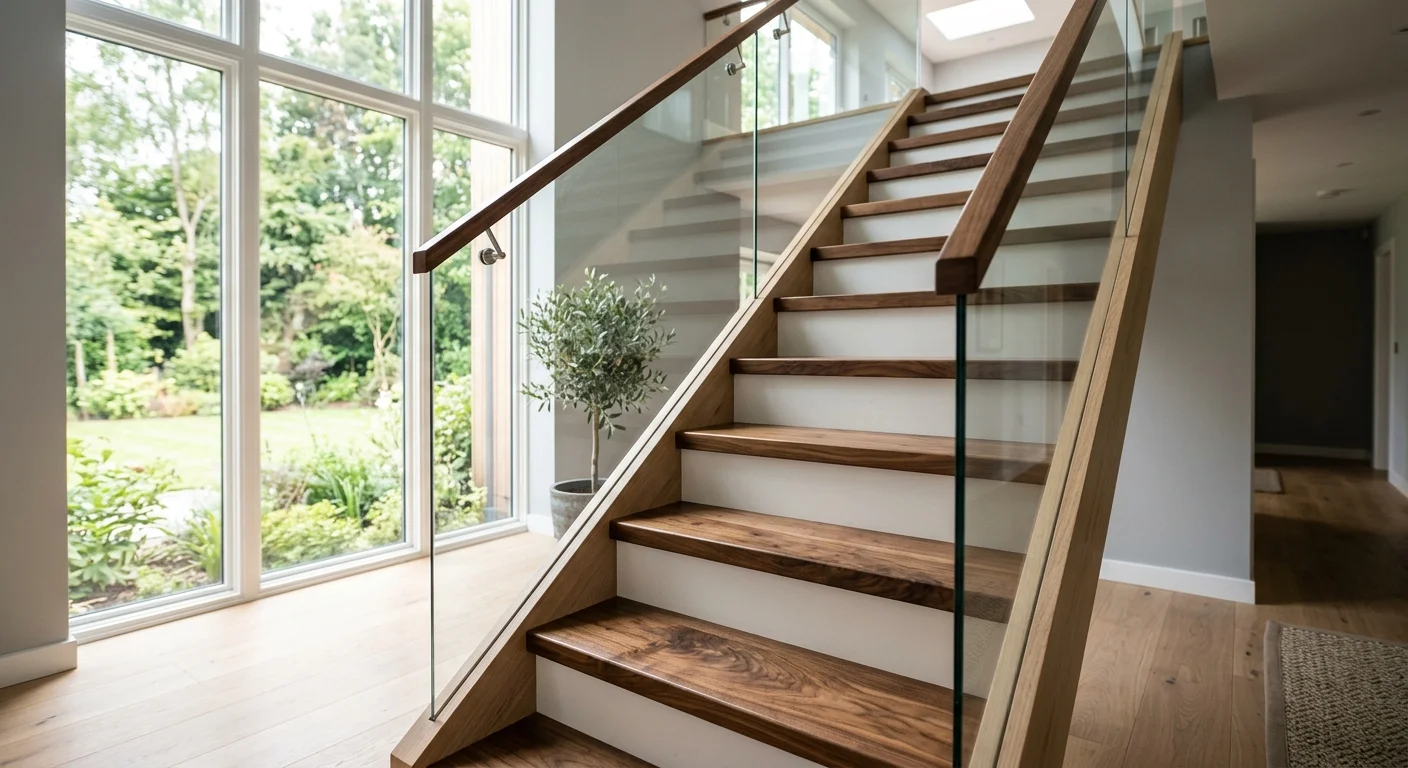
Matching your tread species to your home’s overarching architectural style is essential for creating a cohesive design statement that enhances your property’s value. When exploring luxury staircase design elements, designers frequently emphasize the visual transition between the stair treads, the risers, and the handrails. The choice of wood can anchor a space, transforming a simple functional structure into a stunning focal point.
For modern and minimalist interiors, thick, blocky floating stair treads are highly popular. White Oak and Hard Maple are the best woods to use for stair treads in these clean, contemporary layouts. Their subtle, uniform grain patterns pair beautifully with glass panels, stainless steel cable systems, and minimalist steel mono-stringers. Finishing these woods with a clear, matte penetrating oil preserves their natural, raw appearance while protecting the wood fibers from dirt and foot oils.
Traditional and transitional homes benefit from the classic warmth of Red Oak or Black Walnut treads. In these settings, stained hardwood treads are often paired with painted white risers and decorative wrought-iron balusters. This high-contrast look highlights the natural beauty of the wood grain while keeping the staircase feeling bright and open. Black Walnut treads with a rich satin finish add immediate warmth and historic character to estate homes and classic coastal properties.
Industrial and rustic spaces are the perfect match for thick, distressed hardwoods or reclaimed timbers. Rough-sawn White Oak or character-grade Walnut treads, featuring visible knots and natural grain variations, create a rugged, authentic feel. These heavy treads are often bolted to black powder-coated steel stringers, offering a striking contrast between natural wood and industrial metal. Using species with strong, prominent grain patterns ensures that the wood’s character is visible even from across a large room.
Technical Comparison of Stair Tread Wood Species
Comparing wood species using standardized industry data ensures you select a material that fits your performance and aesthetic expectations. The following table outlines the mechanical and physical properties of the most common hardwoods used in premium stair construction.
| Wood Species | Janka Hardness (lbf) | Average Cost Range (Per Tread) | Dimensional Stability | Best Suited Design Aesthetic |
|---|---|---|---|---|
| White Oak | 1,360 | $120 – $300+ | Excellent | Modern, Coastal, Minimalist, Scandinavian |
| Hard Maple | 1,450 | $90 – $180 | Good | Modern, Scandinavian, Contemporary |
| White Ash | 1,320 | $80 – $150 | Excellent | Modern, Transitional, Industrial |
| Red Oak | 1,290 | $45 – $110 | Moderate | Traditional, Craftsman, Classic American |
| Black Walnut | 1,010 | $180 – $350+ | Excellent | Luxury, Formal, Transitional, Mid-Century Modern |
| Brazilian Cherry | 2,350 | $150 – $280 | Moderate | Exotic, Traditional, High-Traffic Commercial |
Key Factors to Consider When Choosing Stair Tread Materials
Evaluating critical structural, environmental, and financial factors beforehand ensures your hardwood treads perform flawlessly for decades. While appearance is often the first thing homeowners look at, several hidden variables dictate how well a wood species will behave in your specific home environment.
- Household Traffic and Pet Activity: Homes with large dogs, active children, or heavy indoor shoe use require ultra-dense hardwoods like Hard Maple, White Ash, or White Oak. Softer woods like Walnut will scratch and dent under heavy claw pressure, requiring frequent touch-ups.
- Color-Matching and Grain Coordination: Consider whether you want your staircase to match your existing hardwood floors or provide a stark, beautiful contrast. White Oak offers the most neutral base for staining, while Red Oak is best for matching traditional red-oak flooring.
- Structural Engineering and Thickness: Standard stairs built over solid sub-steps can use thin 1-inch treads. However, floating staircases require thick, engineered, or solid 3-inch to 4-inch structural slabs that can support hundreds of pounds without flexing or warping.
- Finishing Systems and Maintenance: Film finishes like polyurethane provide a tough plastic shield but can scratch and peel. Penetrating oils bind directly with the wood fibers, preserving the natural texture and allowing for easy on-site repairs without sanding the entire step.
- Budget and Material Availability: Hardwood pricing fluctuates based on grade, thickness, and regional availability. Opting for a domestic hardwood like Ash or Red Oak can save thousands of dollars on a large project while still providing incredible strength and beauty.
Common Professional Mistakes to Avoid in Wood Selection
Avoiding standard pitfalls during the wood specification stage will prevent costly structural issues and premature tread replacement down the road. One of the most common errors homeowners make is purchasing thin veneer or engineered treads under the assumption that they perform just like solid wood. Engineered treads consist of a thin slice of hardwood glued over a core of plywood or medium-density fiberboard. While they are stable, they cannot be sanded and refinished multiple times. If a heavy object gouges through the thin veneer, the entire tread must be replaced, which is a costly and destructive process on finished staircases.
Another major mistake is neglecting proper wood acclimation before installation. Wood is a natural, hydroscopic material that expands and contracts to match its environment. If fresh hardwood treads are installed immediately after being delivered to a humid job site, they will cup, warp, or split as the home’s air conditioning system dries the wood out. Professional installers recommend storing the treads in the climate-controlled room where they will be installed for at least 7 to 14 days. This allows the internal moisture content of the wood to stabilize, ensuring tight joints and flat surfaces.
Finally, using softwoods on high-traffic main staircases is a recipe for early structural failure. Poplar is sometimes chosen because it is inexpensive and easy to paint. However, Poplar has a Janka hardness of only 540 lbf, meaning it will dent under the pressure of high heels or dropped toys. If you want painted stairs, use a dense hardwood like Maple or Birch for the treads, and reserve softer, cheaper woods like Poplar for the vertical risers and trim pieces, which do not experience direct physical impacts.
FAQ
What is the most durable wood for stair treads?
Brazilian Cherry and Hard Maple are the most durable domestic and exotic hardwoods for stair treads, boasting exceptionally high Janka hardness ratings. White Oak also offers outstanding durability, combined with excellent dimensional stability that prevents warping in humid climates.
How thick should wood stair treads be?
Standard staircases typically utilize treads that are 1 inch to 1-1/16 inches thick. Modern floating staircases, however, require thick, heavy-duty solid wood slabs that are 3 to 4 inches thick to meet building code safety requirements.
Which wood is best for stained stair treads?
Red Oak and White Ash are the best woods for stained stair treads because of their large, open pore structures that absorb stains deeply and evenly. White Oak is also excellent if you want to apply modern, neutral gray or white-washed stains without pink undertones showing through.
Can you use pine for stair treads?
While pine is inexpensive and easy to cut, it is a softwood that scratches, dents, and wears down quickly under daily use. It is only recommended for low-traffic basement stairs or utility staircases that will be covered with carpet.
Is White Oak more expensive than Red Oak for staircases?
Yes, White Oak is typically 30% to 50% more expensive than Red Oak due to high global demand, its superior moisture resistance, and its popularity in modern home designs. However, its longevity and ease of staining often justify the higher upfront cost.
When should you choose solid wood over engineered wood treads?
You should always choose solid wood treads if you want a premium staircase that can be sanded, repaired, and refinished multiple times over its lifetime. Engineered wood treads are suitable for matching pre-finished flooring but cannot withstand deep repairs if they are gouged or heavily scratched.
