

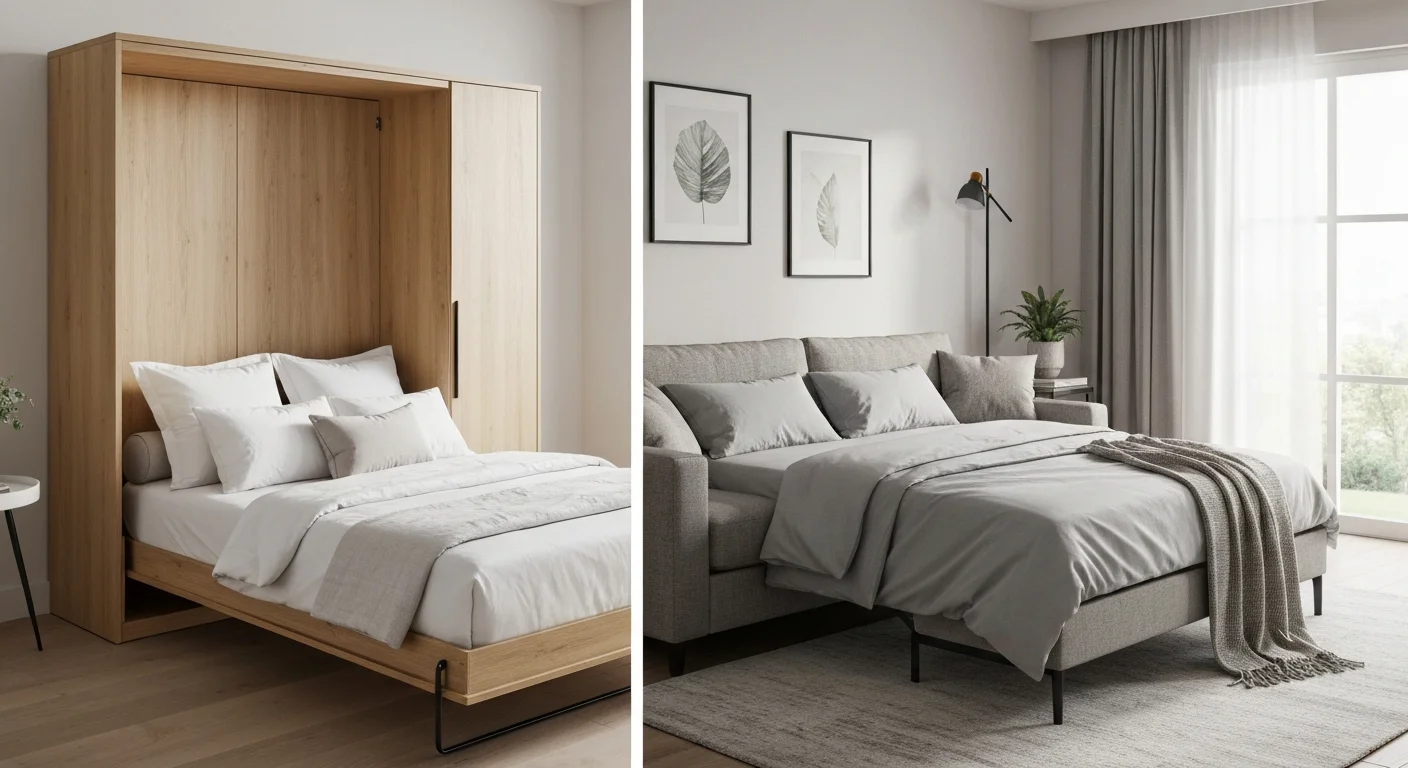
Murphy Beds vs. Sofa Beds: A Comprehensive Guide to Space-Saving Solutions
For long-term comfort, daily use, or dedicated guest suites, choose a Murphy bed. It accommodates a standard, full-depth mattress and supports spinal alignment without middle bar pressure. For studio apartments, casual living rooms, or spaces where daytime seating is a priority and budget is tight, choose a sofa bed. It offers maximum versatility by combining a couch and a temporary sleeping surface in one moveable unit. In 2026, the decision between a murphy bed vs sofa bed hinges on your spatial limits, comfort requirements, and installation flexibility. Wall beds maximize floor space by folding vertically, while sleeper sofas preserve wall space but demand significant open floor area. Reviewing the mechanical structural design, mattress quality, and financial commitment of both furniture types helps determine the ideal solution for your home layout. Consider whether your priority is preserving floor space or retaining the ability to rearrange your furniture layout in the future.
Key Takeaways
- Comfort: Murphy beds use standard mattresses up to 12 inches thick, whereas sleeper sofas rely on thin, folding mattresses that offer less spinal support.
- Space Utilization: A wall bed folds entirely flat against the wall to free up floor space, while a sofa bed occupies constant floor area as seating.
- Portability: Sofa beds are freestanding and easily moved during a relocation, whereas Murphy beds require secure structural anchoring and are considered semi-permanent.
- Multi-functionality: Modern Murphy beds often integrate desks, wardrobes, or shelving, while sofa beds focus primarily on daily living room seating.
- Investment: Wall beds require a higher initial purchase and installation cost but offer superior longevity and home resale value compared to typical sleeper couches.
Understanding the Mechanics: Murphy Bed vs Sofa Bed Designs
The underlying mechanics of these two space-saving systems determine how easily they operate and how long they last. A wall bed utilizes heavy-duty counterbalanced springs or gas piston hinge systems. These systems allow a user to lower a heavy wooden frame with minimal effort. To fully grasp this design, one must explore what is a Murphy bed in its modern context, where precision engineering ensures the bed frame floats down safely. This counterbalanced system does most of the physical lifting for you.
In contrast, a sleeper sofa relies on a metal trifold mechanism tucked beneath the seat cushions. Operating a sofa bed requires removing loose cushions, reaching into the frame, and pulling the heavy metal structure up and outward. This repetitive pulling action can strain the lower back and wear down the internal upholstery over time. Over decades of refinement, wall beds have evolved to include dual-utility features like shelving that remains completely level even when the bed is lowered, whereas sofa beds remain restricted to their static dual-purpose design.
The Comfort Conundrum: Mattress Support and Sleep Quality
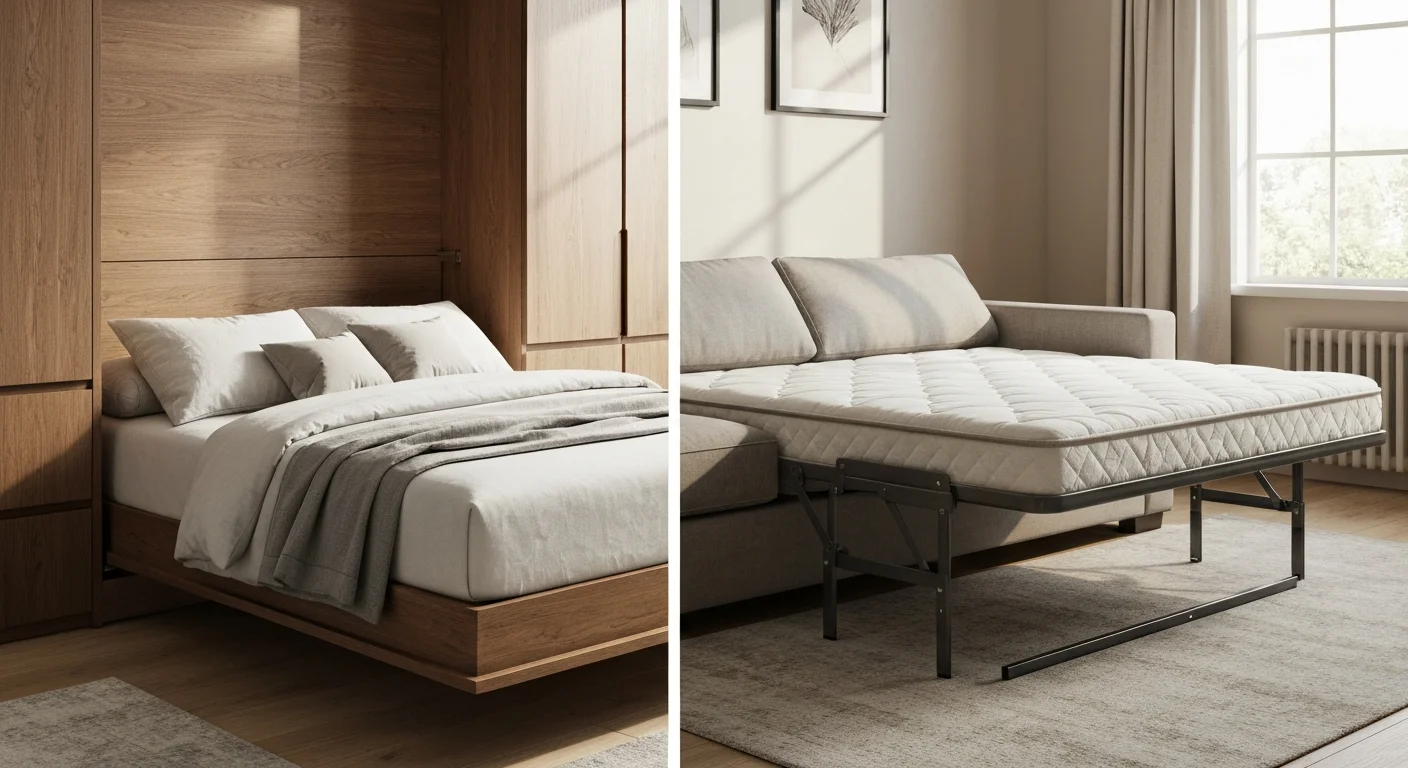
Sleep quality remains the most significant differentiator when comparing a sleeper sofa vs murphy bed. Murphy beds do not require specialized folding mattresses. They accommodate standard coil, memory foam, or latex mattresses up to 12 inches thick, resting on a flat, solid wooden platform or wooden slats. This setup replicates the exact sleeping experience of a traditional residential bed. It ensures that the sleeper receives proper lumbar support throughout the night.
Conversely, sleeper sofas require a thin mattress, usually four to six inches thick, to fold into the couch frame. These mattresses often feature low-density foam or thin coils that compress quickly under adult weight. Guests frequently feel the metal support bars and frame joints through the thin padding. Research by the National Sleep Foundation shows that 75% of adults associate mattress support directly with sleep quality, highlighting the structural disadvantage of thin sofa bed cushions. For any situation involving consecutive nights of sleep, the wall bed provides vastly superior spinal alignment and pressure relief.
Spatial Impact and Room Footprint of a Sleeper Sofa vs Murphy Bed
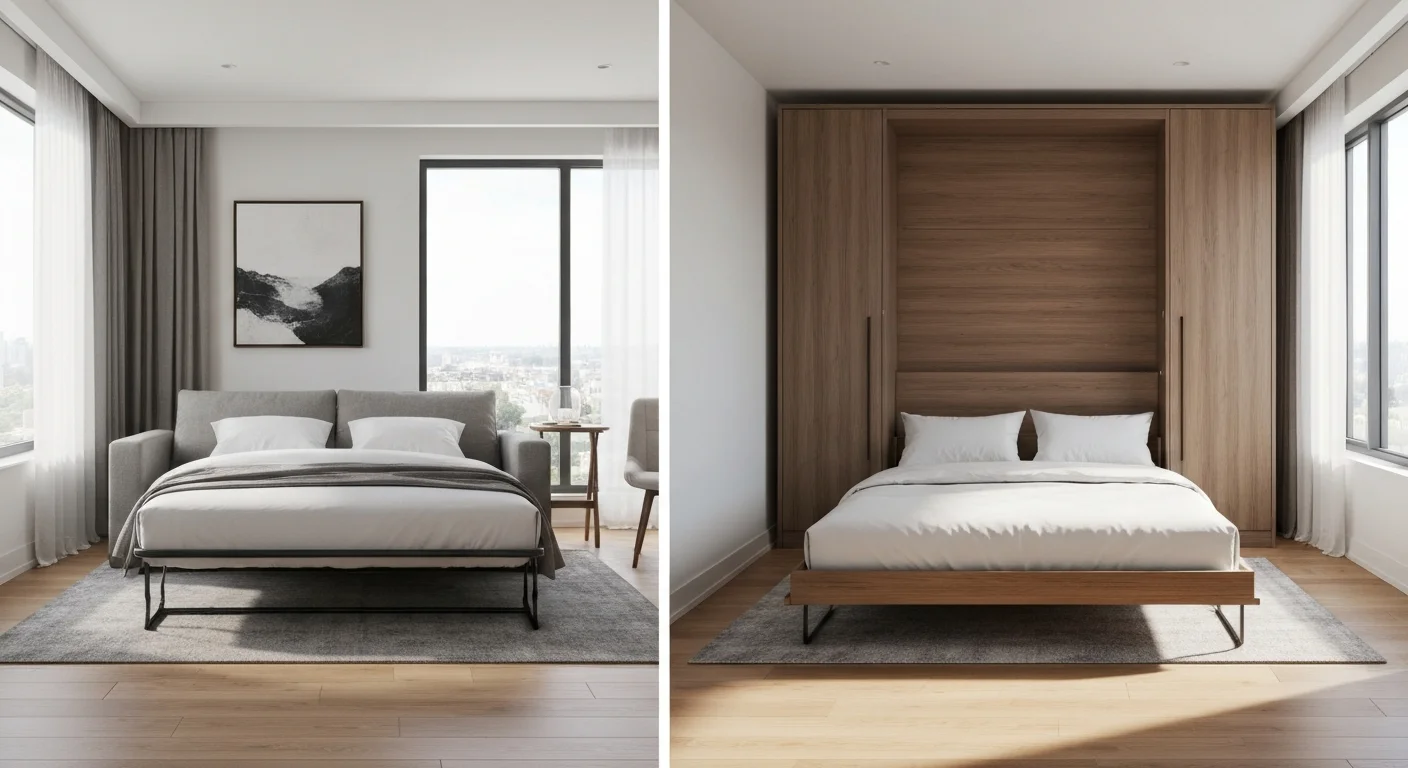
Preserving floor space requires a careful analysis of the physical footprint of each option in both open and closed positions. When closed, a Murphy bed occupies a minimal depth of 15 to 20 inches against the wall. This design frees up the entire center of the room for daytime activities, making it perfect for home offices. Homeowners can select a Murphy bed with desk to create a highly functional workstation that instantly transitions into a guest room at night.
A sleeper sofa, however, maintains a constant footprint of roughly 35 inches deep and 70 to 90 inches wide, even when closed. When opened, both systems extend roughly 80 to 90 inches into the room. The critical difference is that the sofa bed requires you to clear and rearrange coffee tables, rugs, and accent chairs every single night. The wall bed integrates directly into the vertical perimeter of the room, leaving the central floor area permanently unencumbered when folded.
Comparative Costs, Longevity, and Value Analysis
Evaluating the financial commitment requires comparing both the initial purchase price and the projected lifespan of each system. Standard sleeper sofas range from $500 for budget models to $3,000 for high-end designer pieces. While initially more affordable, the mechanical joints in a sofa bed tend to loosen, and seat cushions sag within five to seven years of regular use. The mattress also degrades quickly due to the stress of being folded constantly.
A custom Murphy bed represents a more substantial upfront investment. High-quality wall bed systems typically cost between $1,500 and $6,000, depending on custom cabinetry, materials, and integrated features. However, their structural frames and piston systems often come with lifetime warranties, easily lasting over twenty years. Additionally, built-in furniture can positively impact home appraisal values. The National Association of Home Builders reports that high-quality built-in wall beds can return up to 60% of their value during home resale assessments, acting as a semi-permanent architectural upgrade. Thus, while a sofa bed offers a lower barrier to entry, a wall bed delivers superior long-term financial value.
| Feature | Murphy Bed System | Sleeper Sofa System |
|---|---|---|
| Mattress Support | Excellent (Accommodates standard mattresses up to 12″ thick) | Fair to Poor (Uses thin 4″ to 6″ folding mattresses) |
| Floor Space Utilization | High (Folds flat against the wall, taking only 15″-20″ of depth) | Moderate (Permanently occupies floor space as a couch) |
| Installation Requirement | Structural mounting to wall studs required | No installation needed; freestanding design |
| Portability | Difficult to relocate once anchored | Highly portable and easy to rearrange |
| Lifespan | 15 to 20+ years of active use | 5 to 7 years before cushion/mechanism wear |
| Average Cost Range | $1,500 to $6,000+ (depending on custom woodwork) | $500 to $3,000 (depending on fabric and brand) |
Practical Installation and Portability Considerations
The installation process highlights a major practical divergence between these two furniture options. A sleeper sofa is a completely freestanding unit that requires zero installation. You simply carry it into the room, position it, and it is ready for use. This portability makes it the ideal choice for renters who move frequently or homeowners who like to rearrange their living spaces. It requires no physical modification to the building itself.
On the other hand, a Murphy bed is a structural installation that must be securely anchored to wall studs. As an expert recommendation, homeowners should never attempt to mount a wall bed into plaster or drywall alone; it requires secure lag bolts driven directly into structural wood or metal studs to prevent catastrophic tipping accidents. This anchoring requirement means a wall bed is not easily moved once installed. Removing it requires dismantling the cabinetry and patching the wall studs. This makes it less suitable for short-term rental properties but highly advantageous for permanent residences seeking a built-in aesthetic.
Design Aesthetics and Cabinetry Customization
The visual impact of your chosen furniture piece plays a critical role in the overall interior design of your home. A sleeper sofa looks like a standard couch, which helps it blend seamlessly into traditional living rooms, dens, or playrooms. However, its aesthetic is limited to upholstery fabrics and classic sofa styles. It cannot easily be hidden from view if you want to use the room for a formal purpose.
In contrast, modern Murphy beds offer a sophisticated, built-in architectural look. When folded up, they resemble clean, contemporary cabinetry or custom wardrobes. You can customize the surrounding woodwork with open bookshelves, display ledges, clothing wardrobes, or integrated LED lighting systems. According to urban density research by the U.S. Census Bureau, urban living spaces have shrunk by an average of 10% over the past decade, driving the demand for multi-functional furniture that matches high-end architectural finishes. A wall bed can be custom-painted or stained to match your baseboards and crown molding, making it look like a natural extension of the room’s permanent architecture.
Maintenance and Mechanical Longevity
Maintaining the mechanical parts of your space-saving furniture is essential for safety and smooth operation over the years. Sleeper sofas feature numerous moving metal joints, rivets, and springs that can squeak, bend, or rust over time. Dirt, dust, and small items can easily fall into the folding mechanism, causing it to jam or damage the internal mattress. Cleaning under and inside a sleeper sofa requires heavy lifting and tedious vacuuming.
Murphy beds, while structurally more complex, require very little ongoing maintenance once properly installed. The counterbalanced gas pistons or spring lift mechanisms are self-contained and designed for thousands of cycles without degradation. You only need to occasionally check the wall anchor bolts to ensure they remain tight and secure against the studs. Because the mattress stands vertically when stored, it actually benefits from excellent airflow, preventing the buildup of moisture or dust mites that can occur in mattresses folded tightly inside a dark sofa cavity.
Safety Considerations and Weight Capacities
Safety is an essential factor to analyze when introducing moving furniture into a home, particularly one with children or pets. Modern Murphy beds are engineered with state-of-the-art safety locks and counterbalanced systems. These features prevent the bed from falling open unexpectedly or folding back up while occupied. The heavy-duty frames are designed to support substantial weight capacities, often ranging from 1,000 to 2,000 pounds, because the weight is distributed directly onto the floor through solid legs.
Conversely, sleeper sofas have a lower weight capacity, typically maxing out around 500 to 600 pounds across the cantilevered metal frame. The exposed metal hinges on a sleeper sofa can also pose a pinching hazard during setup and teardown. Children must be supervised around these folding joints to avoid injury. Professional installation of a wall bed eliminates these safety risks entirely, providing a stable, secure, and highly reliable sleeping platform that easily outpaces the physical stability of a folding metal couch frame.
User Scenarios: When to Choose Which System
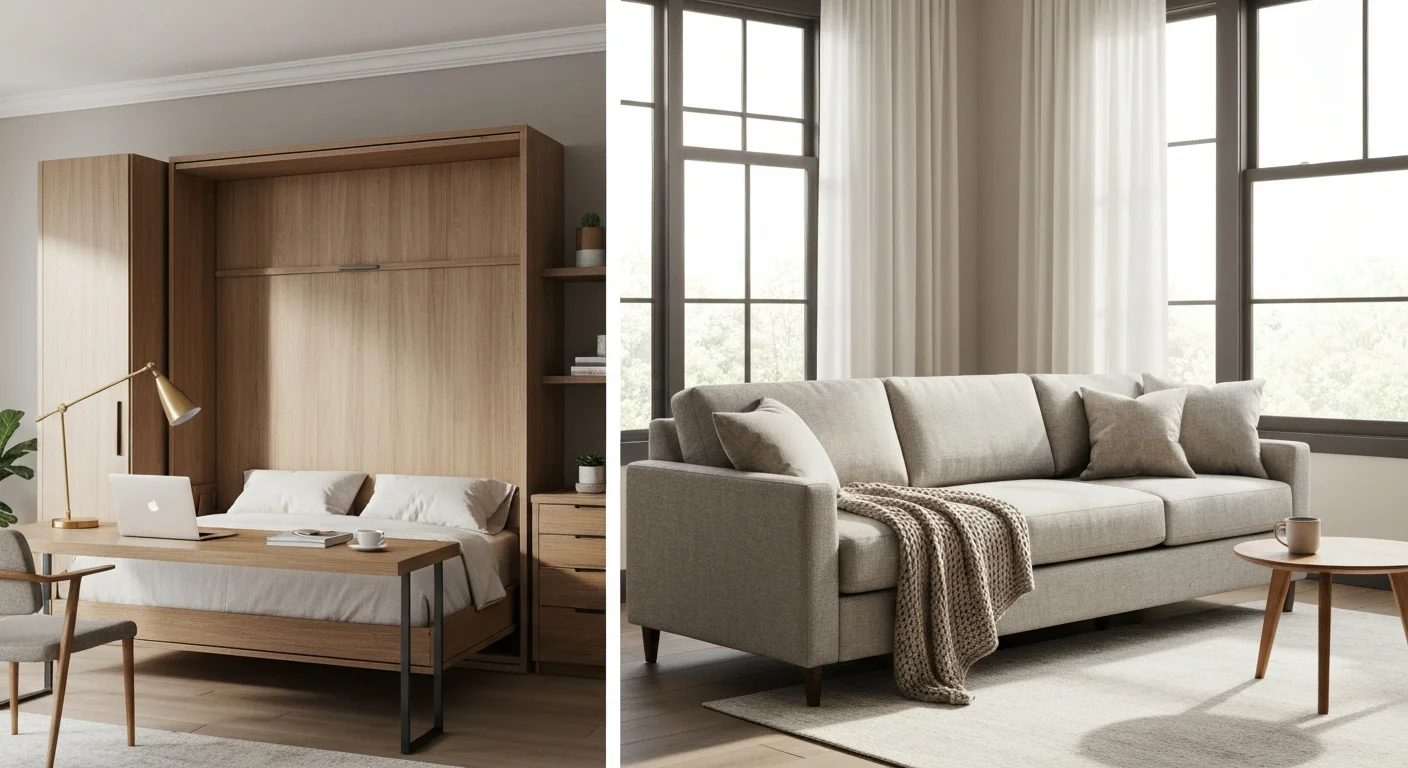
Determining the best fit for your home depends heavily on your daily lifestyle, property ownership status, and room dimensions. Both options solve the challenge of limited space, but they cater to very different domestic situations. Consider the following scenarios to make your final choice:
- The Dedicated Home Office: If you work from home daily, a Murphy bed with an integrated desk keeps the bed completely out of sight during professional video calls. It preserves the clean, executive look of a workspace without the visual clutter of a bed.
- The Multi-Functional Living Room: In a tight studio apartment where you need both primary seating and a bed, a high-quality sofa bed serves as a practical, dual-purpose anchor for the room.
- The Frequent Host: If you regularly host elderly parents or guests for extended stays, a wall bed with a supportive coil mattress ensures they sleep comfortably without waking up with back pain.
- The Rental Property: For renters who anticipate moving every few years, a sleeper sofa offers the mobility needed to transition seamlessly to a new floor plan without leaving behind expensive built-in installations.
Choosing the right system ensures your room remains highly functional without sacrificing comfort or design integrity. Take the time to measure your room’s ceiling height, wall studs, and open floor space before making a final commitment to either option.
FAQ
Can you use a regular mattress on a Murphy bed?
Yes, you can use a standard inner-spring, memory foam, or latex mattress on a Murphy bed. However, you must ensure the mattress meets the depth requirements of the specific cabinet, which is typically between 10 and 12 inches, and stays within the recommended weight limits of the frame.
Is a Murphy bed more comfortable than a sleeper sofa?
Yes, a Murphy bed is generally far more comfortable because it accommodates a standard residential mattress. Sleeper sofas require thin, flexible mattresses that fold into the frame, which often leads to less support and a higher likelihood of feeling metal support bars through the padding.
How long does a Murphy bed mechanism last?
High-quality Murphy bed mechanisms, such as professional piston or counterbalanced spring systems, are designed to last for 15 to 20 years or more. Many premium manufacturers offer lifetime warranties on these hardware components because they are built for daily cycle operations.
Which option is better for a small studio apartment?
The best choice depends on whether you have a separate sofa. If you need both daytime seating and a primary bed, a sofa bed or a Murphy bed with an integrated sofa built onto the front of the cabinet is ideal to maximize your layout without duplicating furniture footprints.
Can a Murphy bed ruin your walls?
A Murphy bed does not ruin walls, but it does require drilling several deep holes into structural wood or metal studs to secure the mounting bracket. When removing the bed during a move, you will need to patch the drywall holes and touch up the paint on those specific wall studs.
What is the weight limit for a sleeper sofa?
Most standard queen-sized sleeper sofas have a weight capacity ranging from 500 to 600 pounds, which includes the weight of the mattress and the sleepers. Exceeding this limit can bend the metal folding mechanism and permanently damage the support frame.
