
Cable Railing vs. Glass Railing: Which Design Fits Your Home Better?
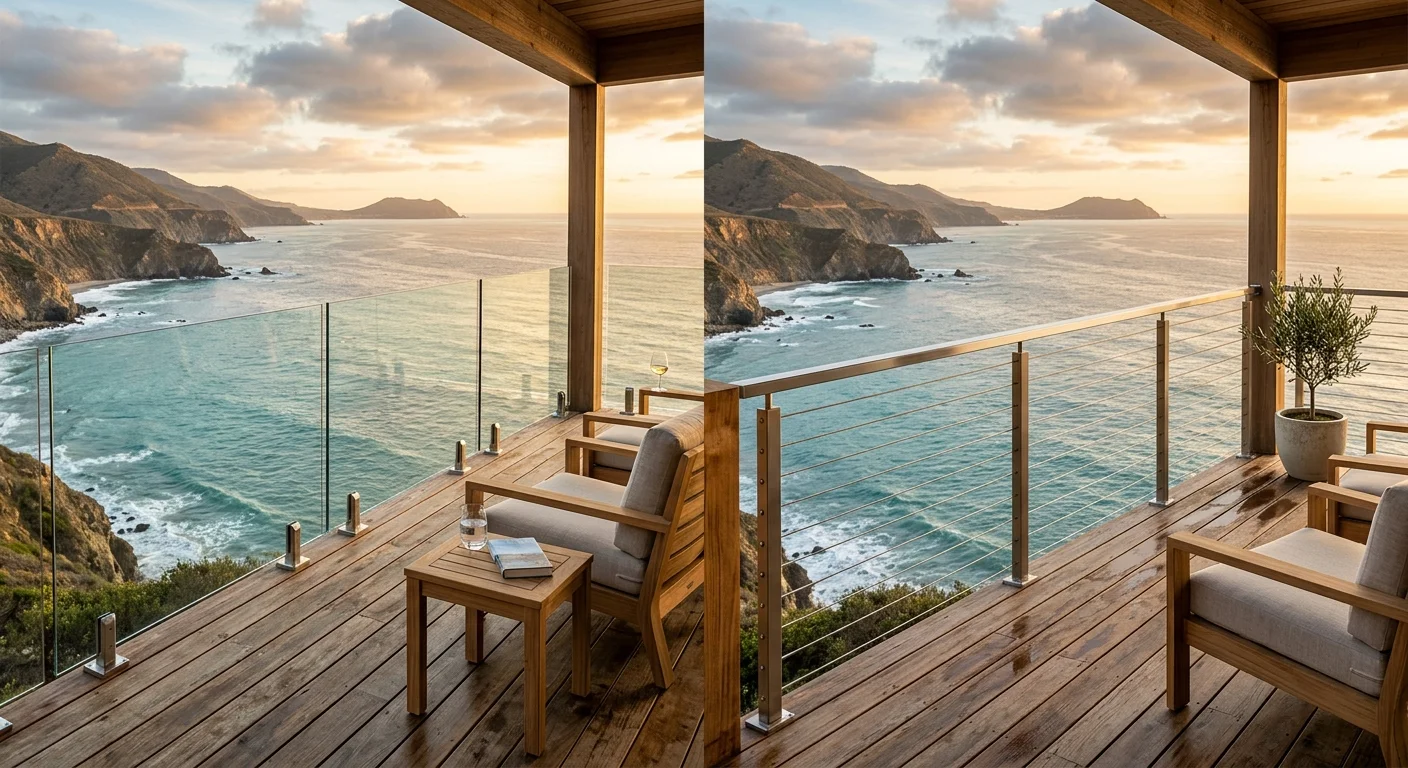
For coastal decks framing a pristine water view or interior staircases seeking a seamless, luxury aesthetic, glass railing systems represent the clear winner. For homeowners prioritizing natural breeze flow, lower upfront material investments, and a sleek industrial-modern look, horizontal cable railing offers an exceptional balance of durability and open visibility. Modern architectural designs frequently weigh these two infill styles when upgrading elevated living areas or grand entryways. While structural cable railing typically ranges between $75 and $150 per linear foot installed, custom glass railing systems generally cost between $150 and $450 per linear foot depending on post mounting hardware and glass panel specifications. Deciding between them requires balancing microclimate factors—such as coastal salt spray and heavy ocean winds—against routine maintenance expectations and sightline priorities. Exterior decks subjected to strong coastal breezes benefit substantially from solid glass windbreaks, whereas cable railing excels in warm environments where continuous air circulation across an elevated space is essential.
Key Takeaways
- View Transparency: Frameless glass railing provides completely uninterrupted 360-degree views, while cable railing utilizes ultra-thin horizontal steel lines that create minimal visual impact.
- Budget Expectations: Cable railing installations cost noticeably less upfront ($75–$150/linear foot) compared to high-end architectural glass systems ($150–$450+/linear foot).
- Climate & Functionality: Solid glass panels block wind and reduce outdoor ambient noise, whereas cable railings promote continuous airflow across hot deck surfaces.
- Maintenance Profiles: Cable systems require periodic tensioning checks and occasional wiping, while glass panels need regular cleaning to remove water spots, salt fog, and fingerprints.
- Code Safety: Both systems fulfill modern building codes when properly engineered, though glass provides a solid barrier that eliminates climbing footholds for small children.
Cable Railing vs Glass Railing for Deck and Outdoor Living Spaces
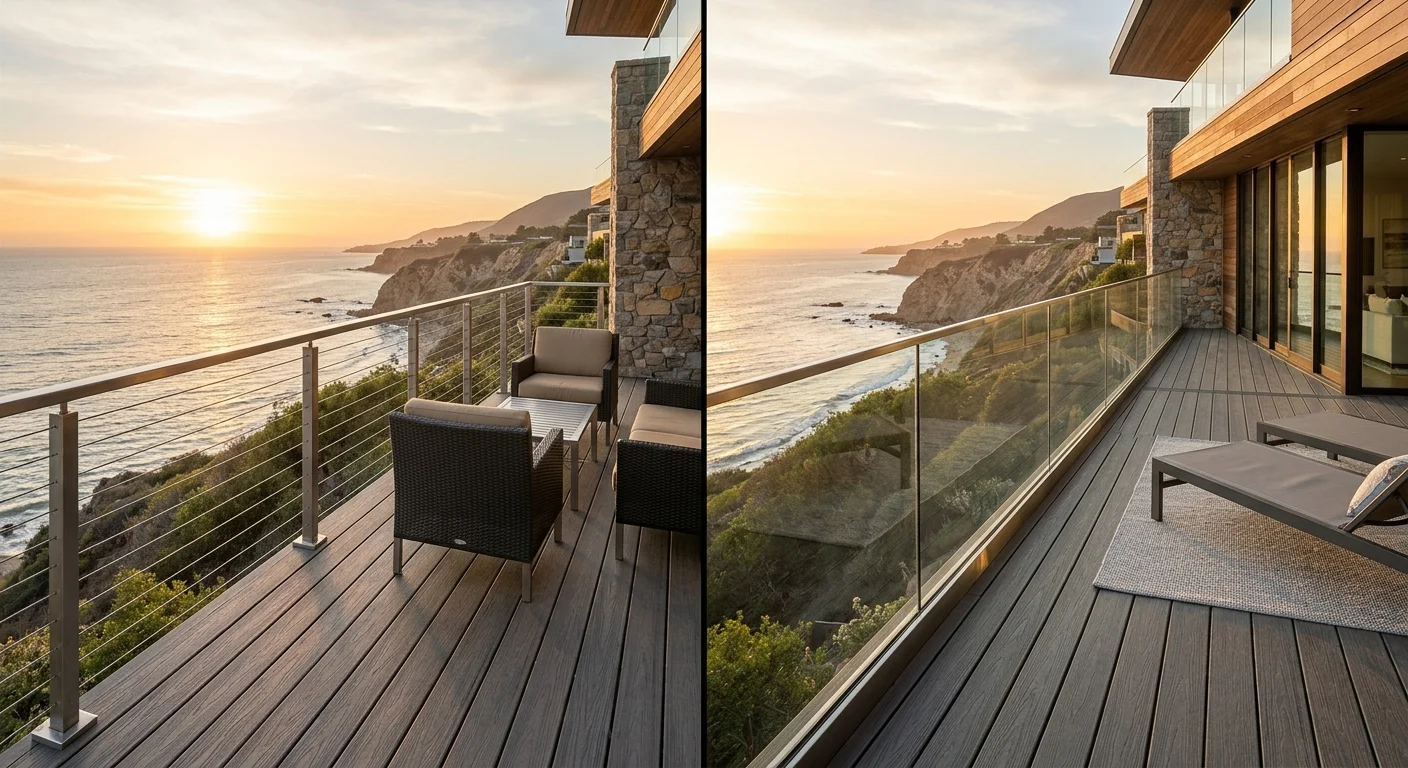
Selecting between cable railing and glass railing for an outdoor deck depends largely on climate conditions, view priorities, and exposure to wind. Outdoor decks elevated above coastal water, mountain valleys, or manicured gardens rely heavily on transparency to integrate surrounding scenery into the living area. Cable systems utilize thin stainless steel cables strung horizontally between heavy-duty structural posts. These micro-cables allow up to 95 percent of natural light and landscape views to pass through freely. However, because cable infill is porous, it allows breeze to pass directly through the deck perimeter. In warm, humid zones across Florida, Texas, and coastal California, this continuous ventilation keeps outdoor entertainment areas cooler during hot summer months.
Conversely, installing glass railing on an outdoor deck creates a solid, transparent barrier. Glass panels act as effective windbreaks, making high-elevation decks, rooftop patios, and oceanfront balconies significantly more comfortable during blustery weather. Research published by the National Glass Association (NGA) indicates that engineered structural glass guardrails effectively absorb wind loads while preserving visual clarity without structural deflection. Glass also serves as a acoustic barrier, dampening ambient street noise or crashing waves. The primary trade-off outdoors comes down to environmental debris. While glass shields the deck from wind, salt spray in marine environments adheres to glass surfaces, requiring routine washing to maintain crystalline clarity.
Material Science and Engineering Behind Cable and Glass Systems
Understanding the underlying engineering of both systems ensures long-term structural integrity and compliance with local building codes. Cable systems utilize 1/8-inch or 3/16-inch diameter 316-grade stainless steel wire ropes. Grade 316 stainless steel contains molybdenum, an alloying element that drastically increases resistance to chloride pitting in marine environments. Studies by AMPP (Association for Materials Protection and Performance) confirm that 316-grade stainless steel exhibits superior corrosion resistance compared to standard 304 steel, making it the mandatory standard for coastal installations. Cable runs require heavy end posts capable of withstanding hundreds of pounds of continuous tension applied by internal swage fittings without bowing or deflecting.
Glass railing systems, by contrast, rely on rigid tempered or laminated safety glass panels. Monolithic tempered glass undergoes rapid thermal quenching during manufacturing, creating surface compression that makes it up to four times stronger than standard annealed glass. When specifying glass for elevated guardrails, selecting between tempered versus laminated glass specifications depends directly on mounting methods and safety requirements. Laminated glass incorporates a clear interlayer (typically PVB or SentryGlas) sandwiched between two glass sheets. If an impact shatters the outer glass, the interlayer holds the fragments safely in place. Mounting hardware options range from discrete stainless steel spigots and surface clamps to continuous aluminum base shoe channels buried within the floor structure for a pure frameless appearance.
For custom residential and commercial projects requiring tailored structural performance, pairing these architectural components with precision engineering ensures exceptional safety. Integrating modern custom glass railing systems allows architects to achieve clean sightlines while meeting rigorous load parameters.
Understanding Cable Railing vs Glass Cost Factors
Comparing the total financial investment of cable railing versus glass railing requires looking beyond initial material prices to include installation labor, specialized hardware, and long-term upkeep. Material costs for cable railing systems are generally lower because stainless steel wire and standard post components can be manufactured in high volume. However, labor for cable railing involves drilling multi-hole post runs, threading individual lines, and manually tensioning every cable to precise torque settings. Glass railing material costs are higher due to custom panel fabrication, edge polishing, heavy toughening processes, and specialized structural mounting hardware like heavy-duty base shoes or hydraulic spigots.
Project budgets vary significantly based on hardware finishes, framing options, and spatial complexity. Straight deck perimeters cost less per linear foot than complex staircases with multi-angle landings or custom curve radiuses.
- Budget Cable Railing: $75 to $110 per linear foot installed (surface-mounted aluminum posts, 316 stainless cable infill).
- Premium Cable Railing: $110 to $160 per linear foot installed (custom stainless steel posts, concealed tensioners, solid hardwood top rail).
- Framed Glass Railing: $150 to $250 per linear foot installed (aluminum post frames with 3/8-inch tempered glass infill panels).
- Frameless Glass Railing: $250 to $450+ per linear foot installed (heavy-gauge 1/2-inch or 9/16-inch laminated glass mounted via continuous base shoes or standoff pins).
Custom modifications, such as powder-coated post colors, low-iron ultra-clear glass, or integrated LED under-rail lighting channels, will increase baseline costs by 15 to 30 percent. Selecting durable materials, like selecting aluminum versus stainless steel structural posts, helps strike the ideal balance between initial budget targets and long-term weather resistance.
Comparison Table: Glass Railing vs Cable Railing Systems
The following side-by-side comparison outlines the key functional, aesthetic, and structural distinctions between these two modern railing styles to assist in system selection.
| Evaluation Metric | Stainless Steel Cable Railing | Frameless / Framed Glass Railing |
|---|---|---|
| Visual Transparency | High (thin horizontal lines present minor visual rhythm) | Maximum (unobstructed, clear 360-degree view) |
| Average Installed Cost | $75 – $160 per linear foot | $150 – $450+ per linear foot |
| Airflow & Ventilation | Maximum airflow (porous design allows breeze pass-through) | Zero airflow (solid barrier acts as windbreak) |
| Routine Maintenance | Low (occasional tensioning checks and surface wiping) | Moderate to High (frequent glass cleaning required) |
| Wind & Noise Reduction | None (wind passes through freely) | Exceptional (blocks wind drafts and dampens sound) |
| Child & Pet Safety | Requires strict 3-inch code spacing (horizontal climbing risk) | Solid protective panel (eliminates climbing footholds) |
Safety, Code Compliance, and Building Standards
Building codes govern guardrail design to prevent accidental falls from elevated surfaces. The International Code Council (ICC) establishes core safety criteria under the International Residential Code (IRC) and International Building Code (IBC). Both cable and glass railings must withstand a 200-pound concentrated load applied in any direction at the top of the rail, as well as a 50-pound per square foot uniform load applied across the infill area. Standard code enforcement mandates that no opening within a guardrail allow a 4-inch diameter sphere to pass through.
For cable railings, achieving the 4-inch sphere rule requires careful engineering. Because stainless steel cables flex when force is applied, installers must space cables no more than 3 inches apart vertically. Additionally, structural support posts must be placed every 4 feet or less to prevent the cables from deflecting beyond the 4-inch maximum under load. Homeowners should also verify local code interpretations regarding horizontal cable layouts, as some municipal building departments evaluate horizontal runs for potential “ladder effect” climbing risks when young children are present.
Glass railing systems satisfy code compliance through solid physical containment. Because a glass panel forms a continuous wall, it completely eliminates openings where children or small pets could slip through or climb. For frameless structural glass installations, modern 2026 codes typically require either a top cap handrail or the use of laminated glass engineered to retain structural support even if one glass ply suffers mechanical damage.
Glass Railing vs Cable Railing Maintenance Realities
Long-term satisfaction with a railing system depends heavily on realistic expectations regarding maintenance routines. Outdoor environments expose materials to ambient pollution, UV radiation, rain mist, and airborne dust. Highlighting the upkeep differences allows property owners to select an infill system aligned with their lifestyle preferences.
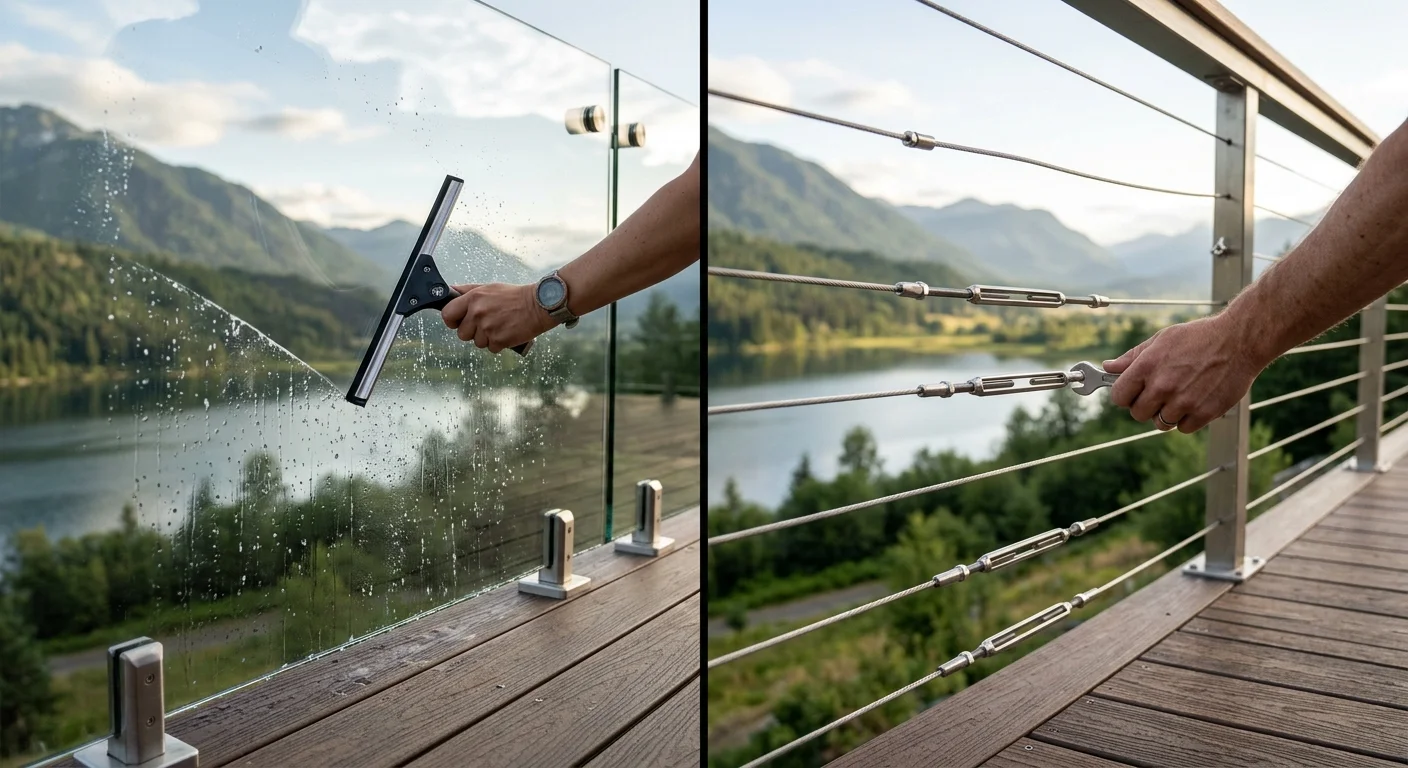
Cable railings require minimal visual cleaning. Stainless steel wire ropes do not show water spots, dust particles, or smudges. Maintenance primarily involves inspecting hardware once or twice a year to ensure cable tension remains taut. Over time, metal settling or temperature shifts may cause slight cable slack, which is easily corrected by tightening the threaded internal turnbuckles using a standard hand wrench. In coastal environments, applying a passivating stainless cleaner once a season prevents tea-staining oxidation on hardware surfaces.
Glass railings demand a consistent cleaning routine to maintain optical clarity. Rain drops, sea spray, dog noses, and fingerprints leave noticeable marks on clear glass panels. Maintaining pristine glass clarity involves specific cleaning protocols:
- Apply a factory-installed hydrophobic surface coating during fabrication to cause water to bead up and roll off naturally.
- Rinse external panels with clean fresh water weekly to flush away abrasive salt crystals and fine sand particles.
- Wash panels using a soft microfiber wand mixed with mild biodegradable dish soap or specialized non-ammoniated glass cleaner.
- Squeegee the surface completely dry from top to bottom to prevent mineral spot formation.
- Inspect rubber isolation gaskets, clamps, and base shoe draining weep-holes every six months to clear accumulated debris.
Aesthetic Compatibility and Architectural Integration
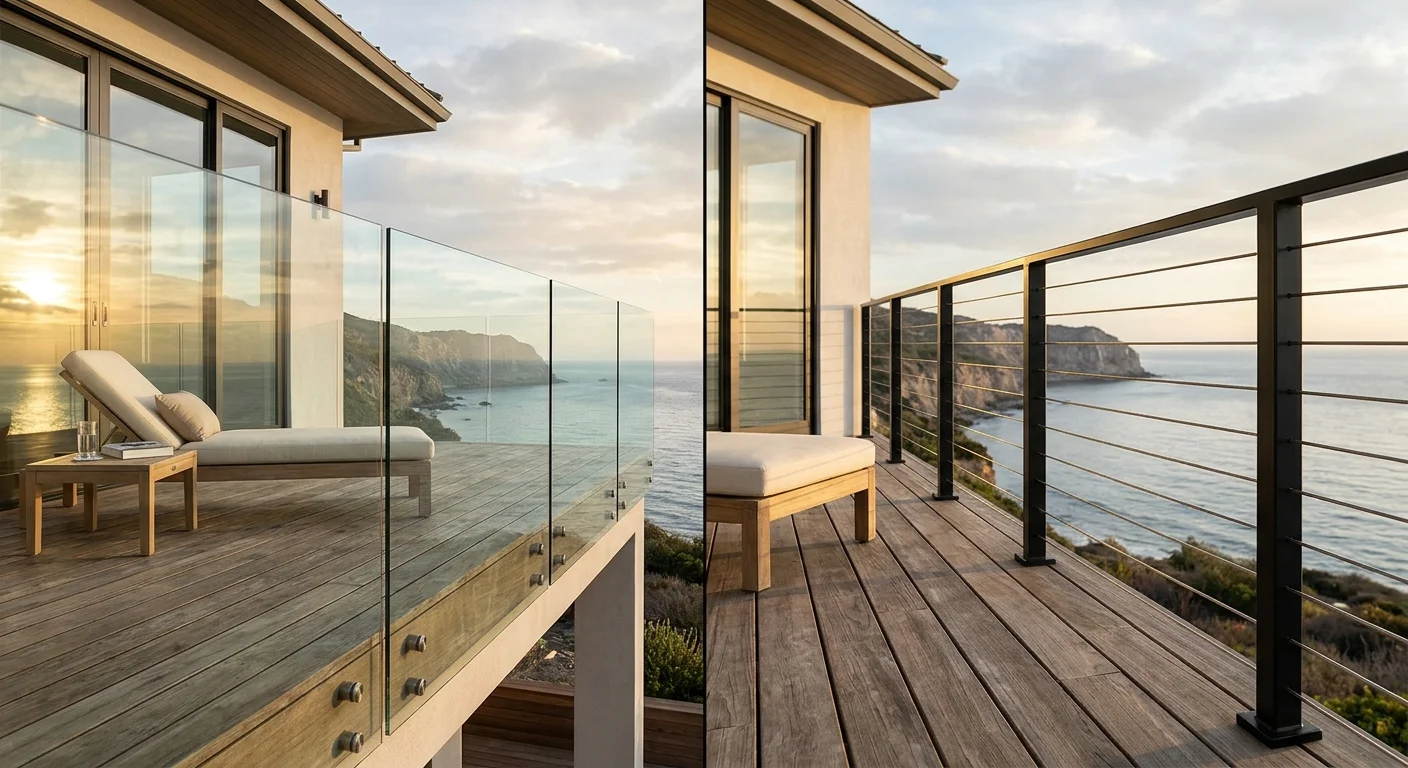
Architecturally, cable and glass railings communicate distinct design languages within residential and commercial spaces. Cable railing integrates seamlessly into contemporary, industrial loft, craftsman, coastal modern, and rustic modern environments. The horizontal steel lines harmonize beautifully with natural wood handrails—such as white oak, walnut, or ipe deck timber—creating a warm organic aesthetic paired with precision steel hardware. When paired with powder-coated black or charcoal aluminum posts, cable systems deliver a bold modern edge that frames nature without dominating the horizon.
Glass railing speaks to modern ultra-luxury, minimalist contemporary, and sophisticated transitional architecture. By eliminating visual grid lines entirely, frameless glass systems prioritize pure spatial continuity. Inside modern homes featuring open-concept floor plans, floating staircases with glass railings allow daylight to penetrate deep into living interiors, keeping staircases visually light and spacious. On oceanfront properties or high-rise balconies, glass disappears against the horizon, focusing attention entirely on panoramic ocean vistas, city skylines, or surrounding forest canopies.
Professional Installation Guidelines and Expert Recommendations
Installing high-tension cable or heavy structural glass railings requires specialized metalworking and glass-handling expertise. Attempting to install these systems without structural engineering calculations often leads to premature failures, sagging lines, or broken glass panels. Professional craftsmen follow strict installation protocols to guarantee long-term performance.
A common mistake during cable railing installation is under-specifying end-post wall thickness. End posts bear the accumulated tension of 10 to 12 taut cables—creating well over 2,000 pounds of lateral pull force on the structural post. Standard thin-walled posts will bend inward over time, causing cables to drop below code-mandated tension levels. Always specify reinforced thick-walled structural steel or heavy-gauge aluminum end posts firmly anchored directly into the building’s floor framing using structural lag bolts.
For glass railings, accurate base shoe anchoring and isolation are critical. Glass panels must never come into direct contact with metal mounting shoes or concrete floors, as point pressure creates localized stress points that can shatter tempered glass. Installers use rubber isolation gaskets, setting blocks, and expanding structural grouts to cushion the panels. Additionally, installers must verify that exterior deck mounting sub-structures include proper waterproofing membranes around post penetrations to prevent water intrusion into joists or ceiling spaces below.
FAQ
What is the price difference between cable railing and glass railing?
Cable railing generally costs between $75 and $160 per linear foot installed, making it the more budget-friendly modern option. Glass railing typically ranges from $150 to $450+ per linear foot installed, driven higher by heavy tempered safety glass manufacturing, edge polishing, and specialized mounting hardware.
Which railing system is easier to keep clean outdoors?
Cable railing requires significantly less cleaning because stainless steel cables do not show fingerprints, dust, or rain spots. Glass railing requires regular washing and squeegeeing to remove dirt, mineral spots, and coastal salt residue from its smooth surface.
Does horizontal cable railing create a safety hazard for children?
When designed correctly, cable railings meet all building codes by keeping vertical cable spacing under 3 inches to pass the 4-inch sphere test. However, because horizontal cables can potentially present a climbing surface for young children, vertical cable options or solid glass panels are often recommended for families prioritizing child safety.
Can glass railings withstand strong coastal winds and storms?
Yes, heavy 1/2-inch or 9/16-inch tempered and laminated glass panels are engineered to handle high wind pressures. Solid glass railings shield decks from strong gusts, making elevated balconies and oceanfront outdoor spaces more comfortable during windy conditions.
How often do stainless steel cables need to be retensioned?
Properly installed cable railing systems using high-grade 316 stainless steel require minimal adjustment. Inspect cable tension once a year; if minor stretching occurs over time, tension can be restored in minutes using internal threaded fittings and a standard hand wrench.
Which railing option provides better view preservation?
Frameless glass railing provides completely uninterrupted 360-degree views because it eliminates visual infill bars entirely. Cable railing offers exceptional view preservation as well, though thin horizontal wire lines remain subtle visual elements within the landscape frame.
